Frustration … that’s what the last few weeks have felt like. On the one hand, my last thyroid biopsy came back benign, … breathe. My March CT scan was clear, … breathe. My genetics testing is in process and likely to confirm I have the PTEN mutation, one more piece of the puzzle falling into place … breathe.
On the other, I’m struggling with running mojo. I have a fussy Achilles that may be new shoes, or just the reality of returning to running volume at 61. I want my endurance to be deeper than it is. And because I’m 7+ months out from finishing treatment, I find myself asking whether this is still a recovery timeline, if it’s de-conditioning, or if it’s a reality of being two years older than when I was diagnosed?
Both Google and my oncologist tell me I’m doing fine, and that my frustration is rooted in the reality my body is still very early in it’s recovery from treatment. That it takes me longer to recover from harder runs is not just de-conditioning, it’s that my bloodwork is still rebuilding itself after being significantly impacted by chemo — both my lymphocytes and hemoglobin remain below baseline.
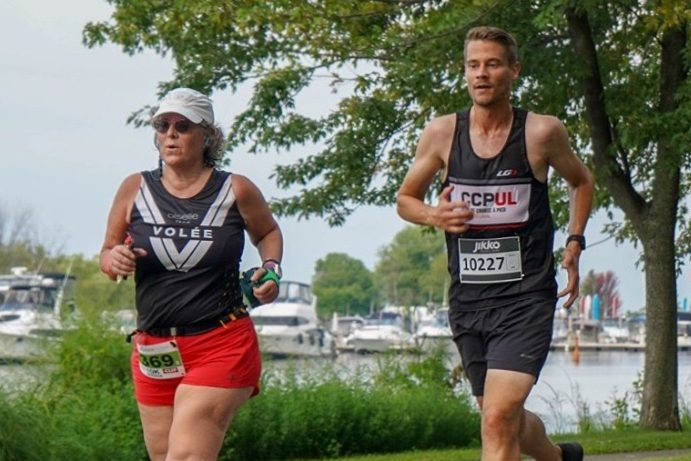
So it’s not my imagination, it IS harder to recover from intense workouts at the moment, and I definitely felt that after my recent 5k. Racing when the temps top 30C is not for the faint of heart, even over shorter distances. I finished in the top three in my age group … but then there were only three women in my age group!
What is working is switching things up so I don’t have a baseline for comparison. The Apple Fitness ‘Time to Walk’ series has become a good companion for walking around my neighbourhood — which doesn’t aggravate my Achilles and still let’s me move my legs.
And my gym recently re-opened after an extended renovation. It has all new equipment, so I have plenty of opportunity to switch up cross-training. There’s a range of kettlebells, a new squat rack, and a rower — once my equipment of choice for a whole body workout that is gentler on your joints.
Where does a Cowden’s diagnosis fit in this picture?
I’m oddly not stressed about the Cowden’s diagnosis that was confirmed at my appointment with the medical geneticist this week. It will be another 4-6 week before the results from my bloodwork — a 31 gene Hereditary Cancer Predisposition panel — come back, but my doctor reminded me that PTEN mutation or not, the Cowden’s diagnosis will stand because I meet the clinical criteria even without the genetic mutation.
In some ways, Cowden’s feels like the missing puzzle piece that brings the bigger picture of my health into focus. The syndrome carries with it higher risks of certain types of cancer — breast, thyroid, renal, colorectal, and endometrial — along with the potential for immune system dysregulation. These manifestations taken together map directly to the benign masses on my mammograms, my thyroid nodules, a cyst/stone on my kidney that periodically appears on my CT scans, my history of uterine fibroids, and — of course — my endometrial cancer.
The good news is that there aren’t any contraindications for running with this diagnosis. Still, my anemia and low lymphocytes may be a consequence of treatment PLUS this underlying genetic condition, so it warrants further investigation. And while it’s nice to know there are reasons my stamina is still a challenge, it doesn’t change the reality that I’m frustrated by 5k being the top end of my running range these days.
My ever-expanding team
I have an appointment with my radiation oncologist on Tuesday. It’s a regularly scheduled followup and my Cowden’s diagnosis will be news. I have a few questions, since Cowden’s brings with it higher radiosensitivity and it might mean monitoring the bladdar and rectal fibrosis that showed up on my last CT more closely. It also increases the risk of secondary cancers, which is already raised by pelvic radiation. It feels like I’ll be giving him and his team some homework to investigate how this will impact my surveillance plan.
Oddly enough, this diagnosis may improve the prognosis for my endometrial cancer, as the gene mutation is associated with better outcomes. I’ll be interested in learning more about that when I meet with my gynecologic oncologist in September.
On the horizon is a referral to a high-risk breast cancer specialist. With an 85% lifetime cancer risk and known masses in both my breasts, I also have questions about surveillance and the sometimes recommended risk-reducing mastectomy. At my age, I’m guessing tighter surveillance with an MRI at the six-month mark between annual mammograms is the most likely scenario, but that remains to be seen.
My current team is six oncology specialists, and likely to grow. I do feel grateful that being Montréal-based I have quality care, mostly accessible by public transportation. It makes what is an increasingly complex health portfolio somewhat easier to manage.
Plans for fall racing
I had hoped to have more range in my distances by now, but that remains a work in progress. So I’m looking at local 5k races again for September and October. I have modest goals of taking a few minutes off my time, and a more ambitious goal of feeling like I have more in the tank when I finish. That would set me up for a 10k race in the spring.
The most likely choice will be the Lachine Bonneville Half Marathon 5k, where I know the course, its fairly flat, and the biggest obstacle is likely the Canada geese that sometimes block your way.
 Running from hysteria
Leave a comment