There is nothing quite like the anxiety of sitting in your oncologist’s waiting room, knowing that on the other side of the door are the results that will shape, or reshape, your future. That was my Tuesday. To my surprise, we landed in an unexpected place. I walked in untethered, not knowing, and I walked out NED. My pathology was Stage I. Exhale, literally …
I sat facing my oncologist, and we both smiled at each other. I was a little shell-shocked. She was clearly pleased to be relaying unexpected good news. We laughed, and then sat together for a moment to let it sink in.
pT2N0M0, R0. Stage I. NED.
Clean margins with 9.5 cm clearance, 0 of 19 lymph nodes involved, moderately differentiated (G2), LVI not identified, PNI present, low tumor budding score.
No adjuvant therapy indicated. Surveillance going forward.
It’s not all coming up roses
Then, even with all this good news, we mapped how my surveillance would be coordinated from here. With no medical oncology role in the short term, my surgeon, whom I see on 18 June, will be the lead. She’ll schedule my post-surgery CT, and then set the colonoscopy schedule that makes sense.
Because I always have to be a bit of a unicorn, the PNI presence in the pathology will influence that timeline. PNI — or perineural invasion — is unusual in Stage I tumors. It carries with it a higher risk of recurrence, and consistent with my dMMR, MSI-high, BRAF+ profile, it indicates more aggressive tumor activity. So even though I have clean margins by a wide swath, PNI means we will watch more closely, which is fine — I’ve become really good at being watched.
It takes a village
That means my CT scans become even more critical to read with care. And those scans need to be coordinated with both my gynecologic oncologist and my thyroid specialist. On the edges of that core team are my medical geneticist, the oncogenodermatoses clinic, and the high-risk breast clinic. They all have a role to play in keeping my systems optimized. We’re just past the F1 weekend here in Montréal, and I can’t help but think about the pit crews who work in such tight synchronization to support the drivers in achieving their goals.
Running on hope
All this good news leads me to think about my running goals for the future. I have the Brave Like Gabe 5k on my calendar, and new shoes to test for that race. But now I have a license to think farther, and see where my body might want to go. True confessions: I’ve been looking at fall 10ks. I’ve been running towards a healthy future for two years now. The idea of being able to just run is liberating.
My Garmin tells the story
Even without running any distance since my surgery, my body has still been running its own marathon in the background: rebuilding my abdominal wall, adapting my newly reconfigured colon, and telling my immune system to stand down from the trauma of surgery. Underneath all that is the anxiety of waiting for results. The comparison of the day of my oncology appointment and the day after is stark.
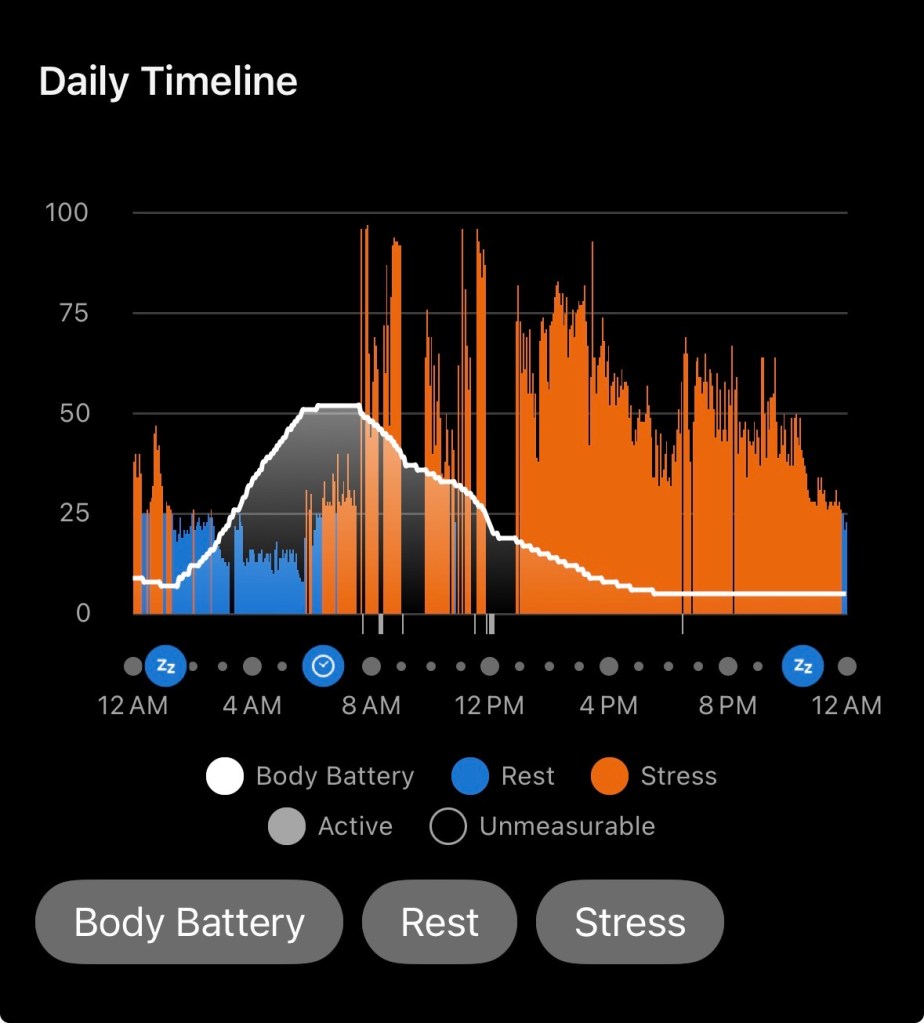
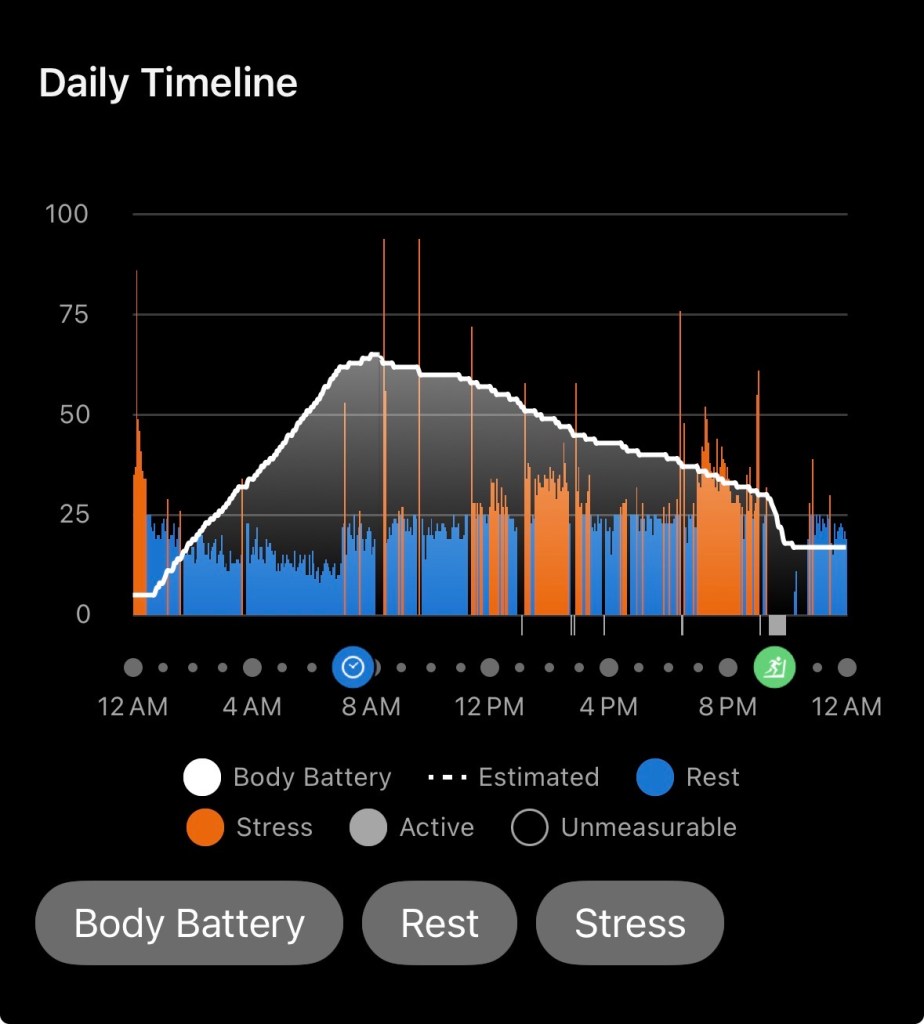
The day of my appointment (26 May) vs the day after (27 May) — happy news!
My peak any day right now is in the mid 60s — an indication in and of itself that my body is in recovery mode — but it’s the stress levels shifting so dramatically that fascinate me. My giddiness post-appointment shows up in real heart rate variability data — better sleep, lower stress, pressure valve released.
Base building
What I have now is a clear road ahead to work on basebuilding for the 25 June, extending my daily walks from 1.5 miles to 2-3 miles at least once each week, and then — presuming my surgeon gives me clearance on 18 June —mixing in some run intervals by the time we get to race day.
It’s been a journey to get here, and I’m grateful for my ‘crew’ who has made it possible.
They’ve given me license to test my boundaries again, and I’m looking forward to toeing that line.
 Running from hysteria
Leave a comment